Wednesday, March 9, 2011

Graphing Change: Obama's State of the Union 2011


Barack H. Obama, 44th President of the United States of America gave his second State of the Union address on Tuesday, January 25, 2011.  This address was given at the beginning of his second year of his first term.  This address, however, has been framed by four significant events; a GOP sweep of the House and near sweep of the Senate during midterm elections, extreme political theater between two parties on ideological lines, a de-escalation of American troops in Iraq, while they increase in Afghanistan, and the shooting of Gabby Gifford’s (Congressional member from Arizona).  As a result of the latter event, Congressional members of both parties (Democrats and Republicans), decided to sit an "integrated” fashion, as a show of solidarity, for one of their near fatally shot members.  We are two months removed from the delivery of this address, and President Barack Obama is still unable to shake a coarsening narrative that includes; he is Un-American, has not brought about change, and is alienating the African American base of the Democratic Party.

After reviewing President Obama's second State of the Union speech, the research reveals the following; it took 13 pages to communicate his ideas, his speech can be divided into 6 categories (Arizona, Domestic, Winning the Future, International, U.S Troops, and You Should Know), and the section on "Winning the Future" took about 54 paragraphs to communicate.  Despite President Obama's rhetoric, that contains his philosophic frame (which translates into his leadership style of governing); a coarsening narrative continues to be waged by the Right, with the help from some African Americans. As a result, this warrants the need to ask a few questions:

1.  How many times does he refer to America and Americans (in some form) in a collective and connective sense?

2.  How many examples of change are offered in this speech?

3.  How can African Americans utilize information from the speech, to help their communities?

4.  How many times is American history used as a reminder of American greatness?

HERE IS WHAT THE RESEARCH REVEALED: CLICK

As for question 3:  How can African Americans utilize information from the speech, to help their communities?

Pursuant to President Barack H. Obama's speech, there are topics that afflict the African American community, to include; gun violence, school reform, higher education, innovation, small business owning, immigration reform, digital age, health care, debt management, and issues of equality.  The following are recommendations that one can use the Speech to conjugate into meaningful action: (click specific words in the recommendations to learn more)

1.  Lobby the NRA, State, Local and Federal Government for gun control laws.

2.  Demand local school boards to educate African American children earlier and longer.

3.  Encourage African American students to attend America's world best colleges and universities.

4.  Engage in opportunities of innovation that are often supported by the Federal Government.

5.  Create a business to compete in the mark of profit and help rebuild America.

6.  Demand youth to finish high school.

7.  Support immigration reform for those coming from Africa, the Caribbean, and the Diaspora.

8.  Create applications that will move the digital age forward.

9.  Understand the Health Care Law because African Americans are often without insurance, suffer from disease, and visit the emergency room most often.

10.  Reign in their debt and save disposable income.

11.  Demand the repeal of any such laws that demonstrate inequality, to include Don't Ask, Don't Tell

In today's coarsening political culture, wherein conservatives and their supporters seek to define Barack Obama, his presidency, and his rhetoric, we must take another look.  The research that has been provided demonstrates the following (just in the second State of the Union); President Barack Obama used some form of America and Americans a total of 241 times, he uses American history to remind us of our greatness 18 times, he cites specific examples of change 61 times, and lastly there are elements of the speech that African Americans can use to strengthen their communities.  More broadly, the speech addressed our domestic economy, and specific steps of how we can win the future (investments in innovation, education, infrastructure, and mangment of the National debt).   Each of us must do our own research and make reasonable decisions based upon the facts revealed in the research.  The stakes for our country-and for African Americans-are too high to ignore.

"We are part of the American family. We believe that in a county where every race and faith and point of view can be found, we are still bound together as one people; that we share common hopes and a common creed..."-Barack H. Obama, 44th President of the United States of America, second State of the Union speech

YOU CAN LISTEN TO THE FULL SPEECH below:


Monday, March 7, 2011

"Brenda's Got A Baby"-An Exegesis


March has been designated as Women’s History Month.  A period of thirty days, in which we celebrate the achievements, contributions, and the Movement of Women in the United States of America.  Like African Americans, Native Americans, and other minority groups, women’s stories have been largely left out of American history books.  These groups have also been blamed for society’s ills and their issues used as political theater, to wedge groups apart during election cycles.  Melissa Harris-Perry writes in The War on Women’s Futures that “aggressive anti-choice legislation coming from the new GOP majority in the House makes perfectly clear that belt-fighting deficit reduction is entirely compatible with an older social agenda committed to pushing American woman out of the public sphere.  In fact, according to Harris-Perry, “these initiatives are well coordinated and poised to make an enormous impact on women’s lives.”

At this point we are poised to examine within the demographic of woman, another group impacted by “these initiatives” are American girls.  This entire demographic is impacted, however, no group is impacted more viciously than those that are poor broadly and African American specifically.  In 1993, a seemingly hip hop tale appeared on Tupac’s 2Pacalypse (1991).  This was the lone single debute from the the album, which appears as the tenth tenth track.  While the narrative is largely about one fictitious character, there are other lesser characters, to include; a mother, father, a cousin, a baby, family, a robber, and clients.  Brenda’s story represented an epidemic that occurred during the early 1990s, while largely unreported today, could become such an epidemic again, pursuant to the political decision being made today that “are well coordinated and poised to make an enormous impact…” on American girls' lives.  How should we understand “Brenda’s Got A Baby” in real terms?

Tupac’s narrative begins with the correlation between Brenda’s pregnancy and her educational preparation.

“I hear Brenda's got a baby
But, Brenda's barely got a brain
A damn shame
The girl can hardly spell her name”


The Black Women’s Health Project reports that one million teenagers become pregnant each year in the United States.  This represents about 13 percent of all U.S. births.  They find that school failure of this group, often precedes early pregnancy and child-bearing.

Tupac proceeds to debunk conventional wisdom, in that Brenda’s pregnancy is not only a personal and private family matter.  He suggests that everyone is impacted (in the home and out) by stating (in his song) that this is “how it affects the whole community.”

“Now Brenda really never knew her moms and her dad was a
junky
Went in death to his arms, it's sad
Cause I bet Brenda doesn't even know
Just cause your in the ghetto doesn't mean ya can't grow”


Tupac invokes a twist in his hip hop narrative and to the accepted studies (on poverty).  Instead of Brenda living with her mother, she lives with her father.  The accepted literature and narrative suggests that half of African Americans almost always live with the mother (Hine, 580).  Still, poverty continues to disproportionately strike children because they live in single-parent households (Hine, 580).  Tupac touched on both social policy and the educational system.  This educational system, for Brenda, failed to help her realize that although she lived in the ghetto, this did not mean that she could not improve her condition.  Thus, Tupac understood that the health of a society depends on a healthy, robust, and loving educational system.

Let us understand the historical narrative that Brenda came of age.  This fictional Brenda was born in 1981.  This means she grew up under the policies of the Conservative Revolution.  A Revolution led by President Ronald Regan-Bush and conservative African Americans.  This Revolution included; opposing equal rights for women, fighting abortion rights, and reversing social programs created during the New Deal era, just to name a few socio-political events.  Attacks on social programs and women specifically continued under the Clinton administration’s signing of the discouraging Welfare Reform Act (1996), Bush Jr’s under-funded No Child Left Behind Act (2000) and we are presently seeing defunding threats made on Planned Parenthood, threats to eliminate 1 billion dollars from Head Start’s budget, to attacking workforces that largely contains women and their ability to organize and collectively-bargain, such as the Teachers’ Unions.  The latter is all occurring under the Obama administration.  This may cause women “to marry younger, to stay in difficult (even abusive) marriages and to rely on male wages (Harris-Perry, “The War on Women’s Futures”).”

“But oh, that's a thought, my own revelation
Do whatever it takes to resist the temptation
Brenda got herself a boyfriend
Her boyfriend was her cousin, now lets watch the joy end”


The Black Women’s Health Project indicates that by age 14, 23 percent of girls will have had sexual intercourse by their teenage years.  Those teenage girls with (developmental disabilities-learning and physical), are at an increased risk of early pregnancy.  In fact, 7 out of 10 girls who had sex before 13 were in the category of unwanted or non-voluntary sex.

“She tried to hide her pregnancy, from her family
Who didn't really care to see, or give a damn if she
Went out and had a church of kids
As long as when the check came they got first dibs
Now Brenda's belly is gettin bigger”


Brenda lives in a male-headed single parent household.  Her father is a junkie.  This means the earning potential is limited, public assistance is meager (as indicated in the song, she lives in the ghetto) and will be poor (Hine, 578).  It could be inferred that she is surrounded by single-parent households.  Additionally, these households are receiving public assistance in the form of (WIC, SSI, and perhaps some other types of assistance).  Therefore, there are children in the community because this assistance is tied to children and single mothers.  Thus, the cycle of dependency becomes a life that is both observable and often continues a life of perpetual poverty.  This guranteed money may be one of many causes for birthing more than one child.  The Black Women’s Health Project reports that half of mothers receiving Temporary Assistance to Needy Families (TANF) were less than 17 years old (Hine, 578).  This same population was also with their first child.  In addition, this population will have had a second child within 24 months of the first child (Hine, 578).  As for Black girls, they are 1.6 times more likely than white girls to have a time span of less than 18 months between deliveries (Hine, 578).  By 1992, 39 percent of Black families earned 15,000 or less annually (Hine, 578).  While at the same time, Black families were coming off the poverty rolls beginning in 1992 to 1998 ending at about 1.7 million (Hine, 578).

“But no one seems to notice any change in her figure
She's 12 years old and she's having a baby
In love with the molester, who's seeing her crazy
And yet she thinks that he'll be with her forever
And dreams of a world with the two of them are together,
whatever
He left her and she had the baby solo, she had it on the
bathroom floor
And didn't know so, she didn't know, what to throw away and
what to keep
She wrapped the baby up and threw him in the trash heep
I guess she thought she'd get away
Wouldn't hear the cries
She didn't realize
How much the the little baby had her eyes
Now the baby's in the trash heep balling
Momma can't help her, but it hurts to hear her calling
Brenda wants to run away
Momma say, you makin' me lose pay, the social workers here
everyday”


While Brenda was having a baby, from 1991-1996, teenage pregnancy fell in 13 states by 16 percent; declines in 4 of these states exceeded 20 percent (http://www.teenpregancy.com/ 3/6/2011).  The states with the largest decline were Maine, Vermont, Alaska, Idaho, and Montana (http://www.teenpregancy.com/ 3/6/2011). Brenda was a fictitious African American teenage girl, however, this is not a problem confined to this population.  Both African American and white teenage girls were also afflicted by the narrative authored by Tupac in the 1990s.  The 1990s saw an epidemic known as “birth and hide (Bjorus, “Discarded Babies May Not Be Unusual).”  Teenage girls were carrying babies to term and undetected.  They birthed these babies, in some cases the baby was still born.  In all cases, these teenage girls birthed anywhere from a McDonald’s parking lot to their own parent home, in the toilet (Bjorus, “Discarded Babies May Not Be Unusual).  In each case, these girls discarded the baby, walked away, and were not charged with any crime.  In such cases, it was cited that; lack of access to contraceptives, abortion, peer pressure, and poor sex education were the root causes of these girls’ actions (Bjorus, “Discarded Babies May Not Be Unusual). 

Yet today, we see the cutting of 154, 000 jobs in education and Obama wants a 33 billion dollars cut in spending (Covert, “With State Budgets…”).  The American Recovery and Reinvestment Act of 2009 is being phased out and the women who receive Medicaid will more impact than those men receiving the same benefit (Covert, “With State Budgets…”) as a result of the phase out.  Thus the persons that could be satisfactorily teaching students and the assistance needed to sustain single-parent families will not be availabe to this vulunerable population. 
 
“Now Brenda's gotta make her own way
Can't go to her family, they won't let her stay
No money no babysitter, she couldn't keep a job
She tried to sell crack, but end up getting robbed
So now what's next, there ain't nothing left to sell
So she sees sex as a way of leaving hell
It's paying the rent, so she really can't complain
Prostitute, found slain, and Brenda's her name, she's got a baby”


As a result of being apart of such African American families below the poverty line, Brenda continued on in the cycle of perpetual poverty.  Another person in a home headed by a single parent (working or receiving assistance) means no additional disposable income.  Because Brenda lives in a poor conditioned dwelling, there will be no personal space for her or the baby.  Further, Brenda added to the 33.1 percent of children to unmarried Black mothers 1960-1990 (Hine, 580), she lived in a central city, which means she added to the location of households headed by Black women (1990), which was at 60.9 percent.  Lastly, Brenda and her baby would have faced gang warfare, high rates of HIV infection, and drug addiction (the latter Brenda succumbed and ultimately died) (Hine, 580).

We should understand that “Brenda’s Got A Baby” was and continues to be very real situation for those who are victims of this narrative written by Tupac.  It is a narrative that contains not only personal choices but both political and public policy decisions, with very real implications.  Cuts to social programs (like education and health care), further limits the choices, where options are not readily available to this most vulnerable, which in this case are American girls.  While Brenda died in her teenage years, her baby is 20 year old.  How will we save him?  Will we ever solve the “Brenda” narrative in this country?  This is a narrative that should not be written again by any American rapper.  Unfortunately, the "Brenda" narrative persists because of the looming cuts to Federal and State budgets.  These cuts always strike our educatonal and health systems.  These are for the vulunerable among us, life saving systems that prop-up these communities across America. What is for certain, this is not the way our society should be celebrating American women and girls and not just during the month of March (Women's History Month).


1.  Share your "Brenda" story or
2.  Do you know her baby (he is 20 now), what is he doing?


SOURCES
Jennifer Bjorhus, "Discarded Babies May Not Be Unusual" http://www.find.galegroup.com/ (March 6, 2011).
Bryce Covert, "With State Budgets Withering, Get Ready for the 'Womancession'" The Nation, http://www.thenation.com/ (March 6, 2011).
Darlene Clark Hine and others, The African American Odyessy (2004).
Melissa Harris-Perry, "The War on Women's Futures" The Nation, http://www.thenation.com/ (March 6, 2011).
Teen Pregnancy, http://www.teenpregnancy.com/ (March 6, 2011).
The Black Womens Health Project, http://www.blackwomenshealthproject.org/
2Pac's Lyrics, http://www.azlyrics.com/lyrics/2pac/brendasgotababy.html (March 6, 2011).

Tuesday, March 1, 2011

Carter G. Woodson, Hip Hop, and The Syllabus


Created as an attempt to "dramatize the achievement of persons of African blood" on February 7, 1926, Carter G. Woodson organized Negro History Week.  This Week was expanded to Black History Month during the 1960s.  Woodson's policy was said to be one of "telling the whole truth and nothing but the truth regardless of whom it affected." 

Hip Hop, at its best continues in this tradition of "whole truth" telling in its more than 30 year history.  The artistry of Hip Hop has at times memorialized Black History as best heard in KRS-1 "You Must Learn,"


to calling attention to the Black community's relationship to the police and ambulatory services in urban centers as heard in J. Dilla's "Fuck the Police" and Public Enemy's "911 is a Joke." 

The goal of  THE SYALLBUS (my mixtape project), like any syllabus is to present the HIGHEST quality of education to the people.  This education is distributed through tracks or "lessons" from each teacher or Rapper, on topics ranging from Black Relationships, Diaspora Knowledge, Black Teen Preganancy as heard in Tupac's "Brenda's Got a Baby"

the concept of Blackness, the Urban condition, Black Femininity as heard in Queen Latifah's "Ladies First"

Black Stereotypes, Black Freedom, and the Black Condition as heard in EarthGang's "Thump, Thump, Thump" (Hampton University's emerging sensation from Atlanta, Georgia and on a personal note former students of my History 107 Survey of African American History course).

This project remains true to Dr. Carter G. Woodson's mission, which is to record (in this case collect) the story of the "people of African blood" and to tell this story "regardless of whom it affected."

I hope you enjoy this mixtape.  I hope it encourages you to take action in some creative and positive way. 

I dedicate this project to The Children of the Light who desire a world full of upliftment, concioussness, correct history, and truth; Amisah (my niece, age 2), Donovyn (my cousin, age 3), and Chloe' (my goddaughter, age 3).

QUESTION:  Does Hip Hop reflect WELL the history and issues of "the people of African blood?


THE SYLLABUS v. 1
With tracks "lessons" from Tupac, Nas, Jay Electronica, and Hampton University's EarthGang.

Why did I create this Project?  I asked myself, Are there songs that have positively memorialized and reflected Black History, Black Relationships, Diaspora Knowledge, Black Teen Pregnancy, Blackness, Black Stereotypes, Black Freedom, and the Black Femininity, and the Black Condition just to name a few?  The ANSWER is YES!  Like any student knows, THE SYLLABUS reflects the HIGHEST of literature that reflects the topics that will be discussed that EVERYONE MUST know.  I present to YOU my research in THE SYLLABUS.


CLICK: THE SYLLABUS on Podcast mixed by @DrUnodAndDubs
Lesson 1The Roots ft Erykah Badu "You got me"
Lesson 2Tupac "Brendas got a Baby"
Lesson 3Earth Gang "Thump thump thump"
Lesson 4Jay Electronica "Exhibit C"
Lesson 5Distant Relative ft Joss Stone & Lil Wayne "My Generation"
Lesson 6Styles P ft Floetry "I'm Black"
Lesson 7Nas "I Can"
Lesson 8J Dilla "Fuck the police"
Lesson 9Grand Master Flash & The Furious 5"The Message"
Lesson 10Pete Rock & CL Smooth "Reminisce"
Lesson 11Public Enemy "911 is a joke"
Lesson 12Doug E. Fresh, KRS One, Kool Moe Dee, Just Ice, Public Enemey, Stetsasonic, D-Nice, Ms. Melody, Mc Lyte "Self Destruction"
Lesson 13Queen Latifah ft Monie Love "Ladies First"
Lesson 14KRS-One "You Must Learn"
Lesson 15Public Enemy"Welcome to the Terrordome"
Lesson 16Public Enemy ft Ice Cube & Big Daddy Kane"Burn Hollywood Burn"
Lesson 17The Jungle Brothers "Black is black"
Lesson 18Mos Def "Umi Says"


Tuesday, February 22, 2011

Kappa Alpha Psi in the Age of Accommodation

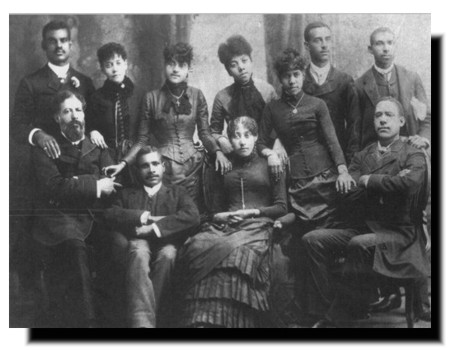
A few of the Founders are seated with Elder Watson Diggs over the "Psi"

CLICK HERE to hear the Brothers of the Kappa Chapter of Kappa Alpha Psi Fraternity, Incoporated sing the Fraternity's Hymn.

The turn of the century for African Americans, particularly in the Southern and Border states was a world of Jim Crow.  This was a world denoted with signs of "white only" and colored only" to remind you of your place in society.  The Federal Government upheld these practices through the Supreme Court's opinion in the Plessy v. Ferguson case since 1896. Following this decision, along with other issues, prompted African American leaders to articulate an acceptance of segregation and that Blacks were best served by accommodating white supremacy, as a means of survival.  However, there was a new generation of African Americans (ten black men specifically) born during the 1890s, who would reject the spirit of accommodation and yearn for the social benefits promised in the American Dream.  These ten men would create a Black Greek-Letttered Organization that challenged the very idea of accommodation and the age in which they lived.  Kappa Alpha Psi's "Five Objectives" explains the membership's ability to undermine the Age of Accommodation.

The period that the Ten Founders of Kappa Alpha Psi was born into was the post-Reconstruction period.  The socio-political condition in the Southern and Border states for African Americans found them both socially and politically segregated through the passage of the Black Codes.  They were also terrorized by the Ku Klux Klan and put to death by their terror tactics of lynching.  In fact, in the year 1900 alone, 815 African Americans and others were lynched.  In the midwestern states, where the Founders were born, all passed laws that upheld the practice of lynching.  This condition was allowed to worsen because as the memory of the Civil War faded, so did antagnonism between white Northerners and Southerners, along with sympathy some white Northerners held for former slaves, also hostility toward southern rebels began to subside.

Then in 1895, Booker T. Washington, assumed the mantle of Black leadership (at the death of Frederick Douglass in the same year) when he delievered his "Atlanta Exposition Speech.""  An address that articulated acceptance of segregation and submission to white supremacy.  "In all things that are purely social, we can be as separate as the fingers, yet one as the hand in all things essential to mutual progress" stated by Washington in this speech was warmly welcomed by whites but bugrudingly by African Americans (in particulary W.E.B Du Bois).  Most whites desired a more permenant solution to the "Negro Problem" and segregation was the answer.  They got their wish from the Supreme Court's opinion in the 1896 Plessy decision, when it declared that facilities could be separate but equal as to not undermine the 14th Amendment.  It did however usurpt it.  Following the ruling, Democrats with the help of Ku Klux Klan memebers and sypathizers passed the Grandfather Clause in Louisana, along with four significant race wars; Washington County, Texas (1896), the Phoenix Riot (1898), Wilimington Riot (1898), and New Orleans Riot (1900).  These events combined to leave African Americans without political rights (the suffrage) and pushed them out of communities, all of which allowed for the Democratic Party to rule the South and vanquish and reduced the Republican Party to a Northern Party.

African Americans had long since used the Church as their spiritual saviour but they now turned the schoolhouse to improve their lot in life.  Not all of America's colleges denied African Americans admissions to their schools, to include Oberlin, Cornell, Butler, and Indiana University.  However, once enrolled, African Americans were not heard from or their issues and concerns were not addressed.  Most African Americans elected to attend all Black schools, like Fisk, Atlanta, Hampton, and Howard.  It is at Howard that two of the would be Founders (Elder Watson Diggs and Byron Kenneth Armstrong) met in the in the 1909-1910 school year.

Given the level of violence in their respective states of Kentucky and Indiana, this may explain why they decided to attend Howard.  Despite the socio-intellectual promise that the District of Columbia and Howard may have possessed, these two men left the city and the school.  It may have been the inability to connect with Atlantic Coast Black Life, Howard's institutional barriers, cost of attendance, and/or their interaction with the Alpha Phi Alpha's Beta Chapter, these two men would reemerge at Indiana University in the 1910 school year poised to make a change.

Elder Watson Diggs and Byron Kenneth Armstrong arrived at the Bloomington campus and found an socially separated and disconnected Black student body.  More specifically they found ten other men (all that was enrolled that school year) who too were disconnected and working their way through school.  Frequent contact between the men sparked a need for a meeting.  Diggs and Armstrong shared their experiences of attending a Negro university, the intellectual capacity of an all Black environment, their experience with a Black fraternity, all which collectively sowed the idea of another more permanent fraternal movement at Indiana specifically and nationally, more broadly.  Though defunct by 1910-1911, Alpha Kappa Nu (1905) along with the existing white Greek lettered organizations had served as a proxy for what would emerge as Kappa Alpha Nu later changed to Kappa Alpha Psi (in name only).  Ultimately, Diggs and Armstrong, along with 10 other men created a fraternity on the premise of "achievement in every field of human endevour" and that there were five objectives that were necessary to achieve this end.  It would be these five objectives that undermined the idea of accommodation.

The objectives of Kappa Alpha Psi did the following; prompted integration, undermined the idea of Negro self blame, supported the idea of protest and agitation, promoted racial solidarity, and undermined the separtist ideology.  All of this against a backdrop of disfranchisment, lynching, jim crow laws, race riots both North and South, and the acceptance of vocational education over a professional and colligate

An examination of the both the Objectives and the demonstrated act:

1.  To unite college men of culture, patriotism, and honor in a bond of fraternity is an example of integration.  The Constituion and Statutes of the organization has never in practice or jurisprudence barred a man from membership due to race.  When World War I came, Founders Elder Watson Diggs and John Milton Lee served their country on the behalf of all Americans.  The Fraternity's Hymn's underlying message is brotherhood solidarity, reminds members of their connnections, and that their work is only done at death.

2.  To encourage honorable achievement in every field of human endeavor undermines the concept of the Negro blaming himself for his percieved lowly position.  Excepting the Delta Chapter (Wilberforce), nine of the Fraternity's first chapters were estabished at white institutions, where jim crow had the most chilling effect on the Black student population.  The Fraternity's first edition of the Journal (April, 1914) shows that "Kappa Alpha Nu has always manifested lively interest in Athletics," members were holding professorships, earned degrees, and were winning scholarships to attend  such schools like Harvard.  At Wilberforce (an all Black school) were vocational education and working with your hands was expected, Wilberforce had defeated Indiana University at a score of "7 to 6" in football.  What this demonstrated is if given the opportunity, African Americans can overcome thier plight if the playing field is fair and the rules are clear.

3.  To promote the spiritual, social, intellectual and moral welfare of members supports the idea of protest and agitation.  One of the Fraternity's first acts following the founding, was the holding of "three-day house party" in May of 1911.  This party introduced black students to the idea of a social affair of the highest order.  This party was noted in Indiana University's student newspaper the "Daily Student."  The Fraternity also purchased a house for the purpose of sustaining membership, survival and ensuring graduation at 721 Hunter Street.  Additonally, Diggs saw fit to create a fraternal magazine, naming it The Journal, that would be published for all membership to record and view the activities of the Fraterntiy.

4.  To assist in the aims and purposes of colleges and universities demonstrates the ability of the membership to work within the legal structures while launching a campaign of solidarity to overcome racism both social and structural.  The Fraternity's focus included establishing chapters at white institutions and all Black institutions of higher learning.  Prior doing so, a letter was sent, announcing the both the function of the Fraternity and the permission to form a chapter.  `Elder Watson Diggs (Grand Polemarch) fashioned such a letter in early 1914 believing that "every college man ought to belong to some such movement as this.   It broadend his horizons and brings him into vital touch and fellowship with college men everywhere."  Each chapter in the early years created activities for the student body to be affiliated with, to include swimming teams, debate clubs, and football.  The Fraternity did suspend members who did not follow University policy and/or the Fraternity's Constitution and Statutes.

5.  To inspire service in the public interest demonstrates the idea of undermining separatist ideology even held within the African American community.  In the beginning Elder Watson Diggs wanted the Fraternity to be a national organization.  This was achieved in May 15, 1911.  This allowed the Fraternity to openly conduct business both domestically and internationally.  It was in the public interest to know the plight and condition of African American people.  This was made possible by both initiating non-black members that became allies and supporting special commissions such as the American Council on Human Rights (an organization established to protect the rights of minority peoples, and to defeat all measures that were inimical to those interests).  Lastly, Elder Watson Diggs because of his World War I service helped to amend the Indiana's State Constitution to "permit the enlistment of Negroes in the National Guard."

In the end, the Founders understood the Age of Accommodation but they did not accept it.  They undermined its both brutal and hostile effects by creating a Fraternity that has  five objectives aimed at its dismantling.  This dismantling did not happen over-night.  What the Founders established and early members maintained, planted the seeds for the Civil Rights generation.  It has been 100 years (January 5, 2011) of the constant protest and agitation of what began with ten men has grown into over 150,000 men and 700 chapters world wide, that continue to smooth out the rough edges of American society and internationally.  It was the five objectives that saw this Midwestern fraternity undermine and defeat the Age of Accommodation.

Thursday, February 10, 2011

Creating a Twitter Quilt of HBCUs


First graduates of Virginia State University (1886)


Click this link to listen to the sounds, the cheering, and commoradery at a Black College while you read!

The Historically Black College and University saga began with the founding of the following schools; Cheyney (1837), Lincoln (1854), and Wilberforce (1856).  Additional "Black" schools recommenced during with the period of Reconstruction(1865-1877) and into post-Reconstruction, with the founding of schools (not limited to) Howard University (1867) and Hampton University in (1868).  Because the writer of this blog is from Virginia, I will take this space to recongize the HBCUs of Virginia, that began at Emancipation Oak (on the campus of Hampton University) which are; Hampton Institute (1868),"a school on a hill" Virginia State University (1882), Saint Paul's College (1888), Virginia Union University (1899) and Norfolk State University (1935).
These schools, while they have largely educated African Americans (resulting from years of racism and segregation), they have never denied any American admissions on the basis of race.  These schools have a wonderful "mosaic" history.  This is to say, that each individual school has contributed successfully to the image, culture, the intellectual contribution, and spirituality to both America broadly and African Americans, those that attended these American institutions most specifically.  Most importantly, the pride, rich tradition, and heritage of these schools, have rebirthed those that have attended and graduated from these institutions.  Its alumni are to be found and counted everywhere within American landscapes and institutions.  While these schools have been around for 174 years, new generations of potential students yearn to know of this wonderment that these now 105 HBCUs possess .  Recently, the 44th President of the United States of America, Barack H. Obama, held a reception on HBCUs at the White House.  This acknowledgement of the HBCU by President Barack Obama, to both remain committed and strengthen the HBCU, added excitment and further inquiry into the story of these American treasuers.
The social network of Twitter has created a space for all Americans and most specifically African Americans to connect and reconnect with unknown and known persons.  These connections, like a quilt, is both broad and loving.  With each connection, like a pattern, has a story to tell. This is the story of the HBCU, a broad patchwork of loving people, with a story to tell that is both unique and interconnected. The world of Twitter reenforces the oral tradition, which has been a corner stone of the African American community. Share your HBCU story through Twitter with these potential students.  Tell them your beautiful story of why they should attend your HBCU? (To learn more about Virginia's Black Colleges)

Monday, January 17, 2011

About The 1619 Project

Within a space of 12 years, the colony of Virginia under the British, had moved from its founding, through its struggle of the starving time, had developed some level of peace with the Native Americans, and now had a cash crop of tobacco.  More specifically, in the year 1619, three distinct events had occurred; the House of Burgess had been established in Jamestown, VA, white woman had come over, and "twenty-some odd Negroes" were traded to the colonist of Jamestown from the hands of the Dutch.  While these Negroes, were slaves in the hands of the Dutch, the English had no laws in Virginia that would have subjected these people to slavery.  These people, like other immigrating Anglo-Saxons had become indentured servants.  These Africans (more specifically, Angolians and Christian) were able to carve out a space for their existance within the English colony of Virginia.  However, between 1650-1750; economic, social, and political events came to bear upon the decendants of these "twenty-some odd Negroes" and the new arriving West Africans, of whom now came into Virginia bound in chains, and some native born African Americans also faced enslavement or offering themselves up into slavery.

Since 1619, from the James River in Virginia and beyond, West Africans (who had become African Americans), have pushed and pulled within the spaces in which they existed.  As framed within the American documents (the Declaration of Independence and the United States Constitution) that represents Freedom, Justice, and Equality (just to name a few enduring American values), African Americans have found ways for both personal and collective attainment of the aforementioned.  They found freedom by running awaying from the plantation, suing for freedom in court, leading slave rebellions, mailing themselves away into freedom, writing, leading protest marches to dancing and singing.

The idea of this project is to "push and pull."  This "push and pull" will happen within this space through the sharing of ideas that one may agree or disagree with BUT the goal is find Freedom, Justice, and Equality rather it be personal or collective as it pertains to the African American community.

Topics can be developed within three spaces: 
1.  Who are Afrcan Americans?
2.  What are African Americans?
3.  Who are African Americans becoming as they move toward the future?

Please follow this hard and fast rule:  all posts are to be respectful and free of discriminatory language that one will find offensive and objectionable.  Remember, these posts represent you.  Always call upon your better angels.